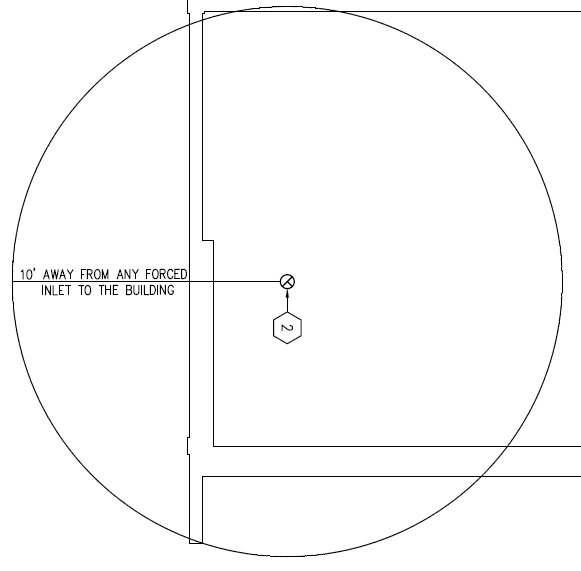
When reviewing plans, you will occasionally come across notes like this:
“10′ away from any forced air inlet to the building”
Or you may receive a detail showing an exhaust fan by itself and wonder why that much separation is required in the first place.
This is not just a graphic instruction. It reflects an important design concept intended to prevent exhausted air from being pulled back into the building.
This distance becomes especially sensitive on projects where an Outdoor Air intake and an Exhaust Fan are located near each other.
People often memorize it as, “Exhaust and intake must always be 10 feet apart.” But in practice, it is not that simple. What matters is not just the number itself, but what the exhaust discharge point is near.
This article breaks down why the 10-foot rule exists, where it applies, and why it can be risky to approach it as a simple rule of thumb.
1. Why is the 10-foot separation needed?
The main reason is cross-contamination prevention.
More specifically, it is intended to prevent re-entrainment, which happens when air that has already been exhausted is pulled back into an outdoor air intake.
For example, imagine a restroom exhaust fan discharging odor and moisture, with an Outdoor Air intake located nearby.
The building can end up pulling back in the same air it just exhausted. It may look like the system is ventilating properly, but in reality, contaminated air is being brought back into the building.
ASHRAE 62.1 addresses separation distance between outdoor air intakes and exhaust or vent outlets, and the purpose of that requirement is fundamentally to prevent exhaust contaminants from being reintroduced into the building.
It also makes clear that this is not just a matter of looking at a flat plan dimension. The review may involve discharge location, elevation, surrounding geometry, exhaust type, and, in some cases, exceptions or additional conditions.
In other words, 10 feet is not simply a distance chosen for convenience or appearance.
It is more accurate to understand it as a separation concept intended to protect indoor air quality (IAQ).
2. What does “forced air inlet” actually mean?
This is one of the most misunderstood terms in this discussion.
A forced air inlet is not just any opening. It means a mechanically driven air intake – in other words, an intake where a fan or piece of equipment is actively drawing in outdoor air.
In practical terms, this would include something like the Outdoor Air intake of an RTU or DOAS.
By contrast, windows and doors are not forced air inlets. They are generally treated as openings into the building.
Publicly available California Mechanical Code reference material summarizes environmental air duct exhaust as requiring separation of 10 feet from a forced air inlet and 3 feet from openings into the building.
The important point is that 3 feet and 10 feet are not competing numbers. They apply to different adjacent conditions.
A clean way to think about it is this:
- 10 feet when the nearby element is an OA intake
- 3 feet when the nearby element is an opening into the building
Once that distinction gets blurred, people start remembering it as, “If it is exhaust, it must be 10 feet.” But the code is not focused on the exhaust fan itself. It is focused on the relationship between the exhaust discharge point and the nearby element.
3. Is the 10-foot distance measured from the fan location, or from the outlet?
This is another common source of confusion.
It is easy to think of the 10 feet as being measured from the exhaust fan unit itself, but for general environmental exhaust, it is more accurate to think in terms of the exhaust discharge point – the outlet or termination point.
That means the focus is not the fan housing as a whole, but the point where the air is actually discharged, and its relationship to a nearby intake or opening.
This matters because the EF symbol shown on the plan does not always represent the exact final discharge location. In ducted exhaust systems or roof terminations, the equipment location and the actual discharge point may not be the same thing.
So in practical review, the first step is usually to look at the separation between the exhaust discharge point and the nearby OA intake or opening, and then, if needed, go further into vertical relationship and other conditions based on the applicable code.
That phrase – “applicable code and other conditions” – is not just vague language. In actual plan review, it usually means checking things like:
- what code framework the project is using
(for example, California Mechanical Code, IMC, UMC, or whether ASHRAE is being referenced) - what type of exhaust is involved
(general environmental exhaust, a more contaminated exhaust stream, grease exhaust, and so on) - whether the nearby element is a forced air inlet or an opening
- whether the condition can be handled under the general rule, or whether it triggers a separate standard, exception, or special requirement
And that information does not appear out of nowhere. In practice, the basis for judgment usually comes from places like the mechanical notes, code notes, equipment schedule, detail callouts, specifications, or adopted code sheets.
Publicly available California Mechanical Code summary language states that environmental air duct exhaust should be separated 10 feet from a forced air inlet and 3 feet from openings into the building, but that summary by itself does not support a blanket statement such as, “It is always 10 feet vertically too,” or “It is always 3 feet vertically too.”
For general exhaust, it is safer to start with the horizontal separation concept, then go deeper into vertical relationship if the specific code path and condition require it.
That does not mean vertical relationship never matters. Once you move into ASHRAE 62.1, the discussion becomes more detailed, including exhaust class, intake relationship, vertical-below-intake conditions, and simultaneous-operation exceptions.
So for a general blog-level explanation, the safest wording is this: it is too broad to say vertical distance is always governed by the exact same number, but it is also not accurate to say vertical relationship is never part of the review.
4. Is “exhaust and intake must always be 10 feet apart” always true?
The most dangerous thing in practice is memorizing a half-true statement as if it were an absolute rule.
Ten feet is a very common number, but it does not apply the same way in every case.
ASHRAE 62.1 does not treat all exhaust air as one single category. Publicly available reference material shows that the required separation from outdoor air intakes can vary depending on exhaust air class. Commonly cited examples include Class 2 at 10 feet, Class 3 at 15 feet, and Class 4 at 30 feet.
A practical way to think about that is:
- Class 2 may include air with a moderate level of contamination or nuisance potential, so 10 feet from an OA intake is a typical representative separation
(for example, restroom exhaust or relatively common non-range-hood kitchen exhaust) - Class 3 may involve stronger contaminants or more objectionable exhaust streams, so the separation increases to 15 feet
(for example, plumbing vents with stack effect, combustion appliance vents, or other more objectionable exhaust conditions) - Class 4 may involve air with greater potential for human health impact, so separation can increase to 30 feet
(for example, chemical storage room exhaust, laboratory fume hood exhaust, or radon mitigation discharge)
So the moment someone says, “It is 10 feet, so that is the end of it,” they may already be skipping over more important conditions.
Ten feet is a very common number. But it does not represent the correct answer for every situation.
5. Why does grease exhaust need to be treated separately?
This point is worth stating clearly from the beginning:
Grease exhaust also has a very important 10-foot separation requirement relative to air intakes.
But that does not mean the review ends once the 10 feet is achieved.
Grease exhaust should not be treated the same way as restroom exhaust or general environmental exhaust. Commercial kitchen exhaust is governed much more heavily by NFPA 96.
Publicly available NFPA 96 reference material shows that rooftop termination is evaluated not only for separation from air intakes, but also for roof clearance, discharge direction, and vertical relationship. Depending on the source wording, the structure may vary slightly, but the core ideas are generally consistent:
- minimum 10-foot horizontal clearance from air intakes
- minimum 3-foot vertical separation when an air intake is within 10 feet
- minimum 40 inches above the roof surface for upblast discharge
So yes, the 10-foot distance is important for grease exhaust.
But it is not enough to say, “If it meets 10 feet, it is fine.”
That is because the 10 feet used for general environmental exhaust and the 10 feet used for grease exhaust may look the same on paper, but they do not carry the same meaning or level of risk.
General environmental exhaust is mainly concerned with re-entrainment and IAQ.
Grease exhaust brings in additional concerns such as grease accumulation, discharge characteristics, fire hazard, and broader fire/life-safety implications.
So it would be inaccurate to say, “Grease duct is basically the same thing as any other 10-foot rule.”
It would also be inaccurate to say, “Grease exhaust automatically requires a bigger number than 10 feet in every case.”
A more accurate statement is this:
For grease exhaust, the 10-foot horizontal separation from air intake is a very important requirement, but it is not the only requirement. Vertical separation, discharge direction, and termination height may also need to be reviewed.
6. How should this actually be judged in practice?
The starting point is simpler than it first appears.
The first thing to separate is whether the nearby condition is a forced air inlet or a window, door, or other opening into the building.
For general environmental exhaust, that distinction usually determines the direction of the review.
- If the nearby element is a forced air inlet, start with 10 feet
- If the nearby element is an opening, start with 3 feet
- If the exhaust is a special case such as grease exhaust, the review does not stop there and NFPA 96 may also apply
So the Exhaust Fan itself is not a “10-foot device.”
What matters is what the exhaust discharge point is near.


Leave a Reply