When checking a single phase AC compressor, one of the first things you may need to identify is the compressor terminals.
Most residential and light commercial compressors have three terminals:
C = Common
S = Start
R = Run
Sometimes the terminal cover or wiring diagram clearly shows which one is which. But in the field, especially on older units, damaged terminals, or after wires have already been removed, you may need to identify them manually.
The safest and most reliable way to do that is by checking resistance with a multimeter.
Before checking the compressor terminals, turn off power to the outdoor unit.
The Basic Rule for Compressor Terminals
Inside the compressor, there are two motor windings:
Run winding: between C and R
Start winding: between C and S
The start winding normally has more resistance than the run winding.
Because of that, the resistance readings between the three terminals follow this pattern:
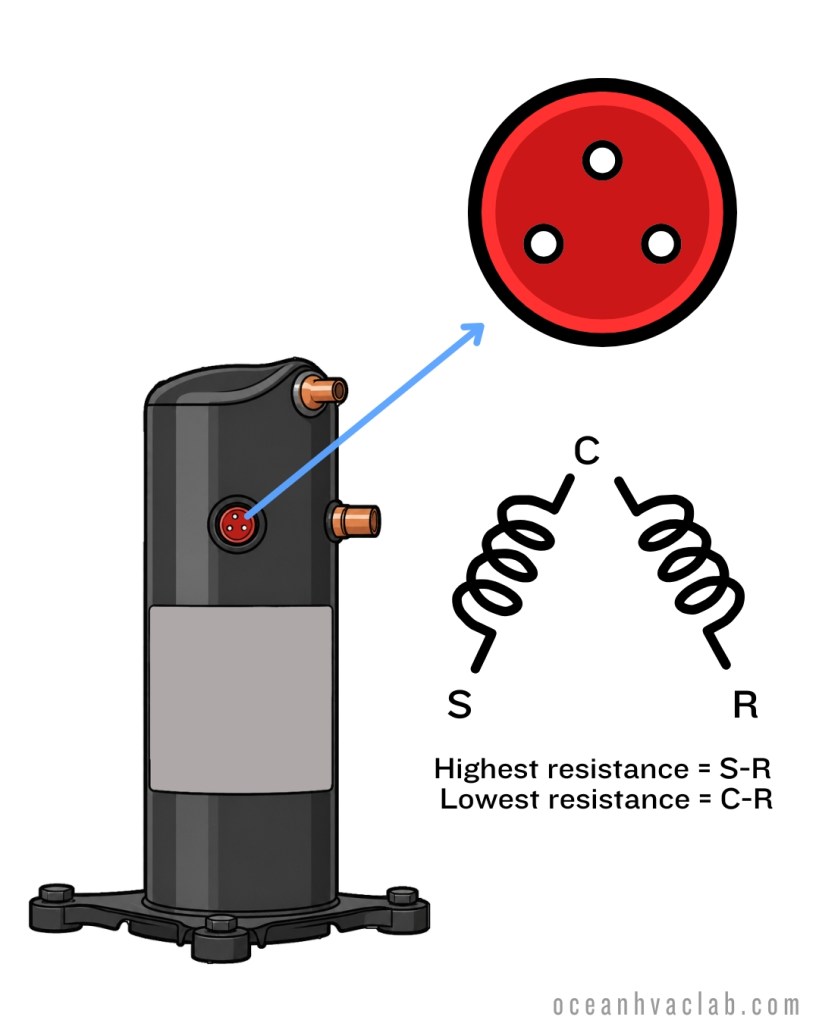
S to R = highest resistance
C to S = middle resistance
C to R = lowest resistance
The direction does not matter.
S to R is the same as R to S.
C to S is the same as S to C.
C to R is the same as R to C.
So when you are checking the compressor, you are not looking for one exact number. You are comparing the three readings and finding which one is highest, middle, and lowest.
Example: Assign Temporary Numbers First
If the terminals are not labeled, do not guess.
Assign temporary numbers to the three terminals:
Terminal 1
Terminal 2
Terminal 3
Then measure resistance between each pair:
1 to 2
1 to 3
2 to 3
Write the readings down.
For example:
1 to 2 = 6.0 ohms
1 to 3 = 2.0 ohms
2 to 3 = 4.0 ohms
Now compare the readings.
The highest reading is 6.0 ohms, so terminals 1 and 2 are S and R.
The lowest reading is 2.0 ohms, so terminals 1 and 3 are C and R.
Now look at the terminal that appears in both the highest and lowest readings.
Highest: 1 and 2
Lowest: 1 and 3
The common number between those two readings is 1.
That means:
Terminal 1 = R
Now go back to the two readings:
The highest resistance was between 1 and 2.
Since terminal 1 is R, the other terminal must be S.
So:
Terminal 2 = S
The lowest resistance was between 1 and 3.
Since terminal 1 is R, the other terminal must be C.
So:
Terminal 3 = C
Final result:
1 = R
2 = S
3 = C
Checking for Short to Ground
A good compressor should not have continuity from any terminal to ground.
To check this, measure from each compressor terminal to the metal compressor body.
You may need to scrape or peel a small spot of paint from the compressor shell to make good contact with bare metal.
Check:
C to compressor body
S to compressor body
R to compressor body
A healthy compressor should read OL from each terminal to ground.
If you get continuity or resistance from any terminal to the compressor body, that means the winding may be shorted to ground. In that case, the compressor is bad.


Leave a Reply